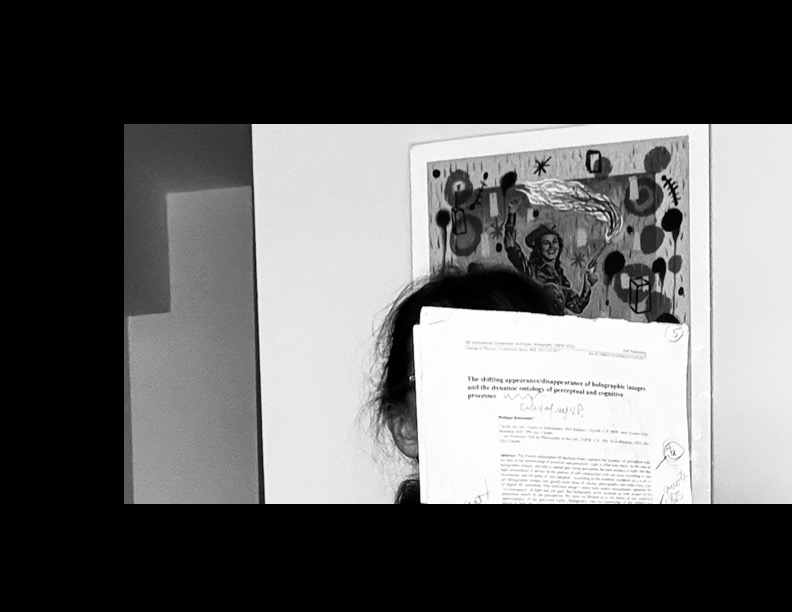
I read this for you. It is written by Phillippe Boissonnet. It was published in the Journal of Physics in 2017. The title is: The Shifting Appearance/disappearance of Holographic Images and the Dynamic Ontology of Perceptual and Cognitive Processes. Whoa. This mind-blowing title perfectly describes the content of the article that was presented at the 9th International Symposium on Display Holography. Who knew brainiacs from around the globe get together and discuss such things. This just shows how fractured and partial mainstream information is. There are people doing amazing work about the nature of reality and how we construct our understanding of it, yet it is not widely talked about. And we are stuck with such words to describe reality and relationships as transparency. Transparency is a word that is only accurate for describing saran wrap and glass. How the hell did transparency become one of our cultural buzzwords?
1. The main point of the article is that how we perceive needs to be included in our understanding of reality. There is so much yapping about what reality is and how life should unfold, yet there is little talk about the human perception that comes up with all the ideas and big plans.
In the Western world perception is typically defined by a separation between the person perceiving (subject) and what is perceived (object). Phillippe Boissonnet and other brilliant intellectuals however, show that there is no separation between us and what we perceive. Perception in this view is described by such words as co-construction and embodied cognition.
Phillippe uses holographs to show the integration of the person perceiving with the object of perception. This is a dynamically unified view of reality. And it is radically different than seeing people as separate from the object of their perception.
The phrase “reality is in the eye of the beholder” is a great reminder that what is perceived originates within us. It does not matter whether a person is talking about political systems, or annoying qualities one believes exist in another person, whatever is perceived is never separate from the person perceiving. Our vantage point and the biases we hold define what we see. A change in position or lessening of biases will result in a change of what we perceived.
This dynamic way of understanding how reality is constructed knocks the idea of truth off its ass because reality is a fluid everchanging experience. And with truth getting the boot uncertainty emerges as an element of perceptual reality. Phillippe describes how the holograph image forms based on the position we see it from. This creates a threshold of appearance and disappearance of the image as our position changes. And like the holograph what we perceive as reality comes in and out of focus depending on our position. These literal and figurative shifts in our position create a border of uncertainty, where things come in and out of focus. I know nobody wants to be uncertain in this culture of truth loving transparency theory zealots. But alas we may finally need to concede that our perception may not be so stable and truthful as we like to believe.
2. The way to integrate this knowledge is to embrace the idea that what you see is defined by your own vantage point and whatever psycho-emotional baggage you carry. And therefore, you must also embrace that what you are seeing is not separate from yourself. This simple starting point could eliminate unnecessary conflict in your life and the world. Just acknowledge that there’s always another reality waiting for you to see that exists on the threshold of appearance and disappearance.
3. The reason it is so important to do something with this knowledge is because you need flexibility and so does the world. Believing our brains are producing truth rather than a perspective coloured by our position is nefarious. This old static way of thinking is the genesis of all the wars and ugliness in the world. It is an arrogant mindset. Knowing that what you see is simply a version of reality, shaped by your position and what you bring to it, is a humble stance. The world needs more humble people.
Now aren’t you glad I read that article for you!
And what about this oh so fancy suit I’m wearing with a lace top. The ensemble is as deceptively fabulous as human perception. What is thought in one moment to be a high-neck lace top reveals itself to be a halter top. Versatility and movement show the full spectacularity of the top. It is like the holograph that reveals itself as the viewer moves around it. Remember your vision is partial and fragmented because it is always on the threshold of appearance and disappearance or the known and the unknown as Phillippe has so brilliantly shared with us. Ideas like clothes can be tried on for a new look. Maybe try on a new way of seeing with your next outfit!